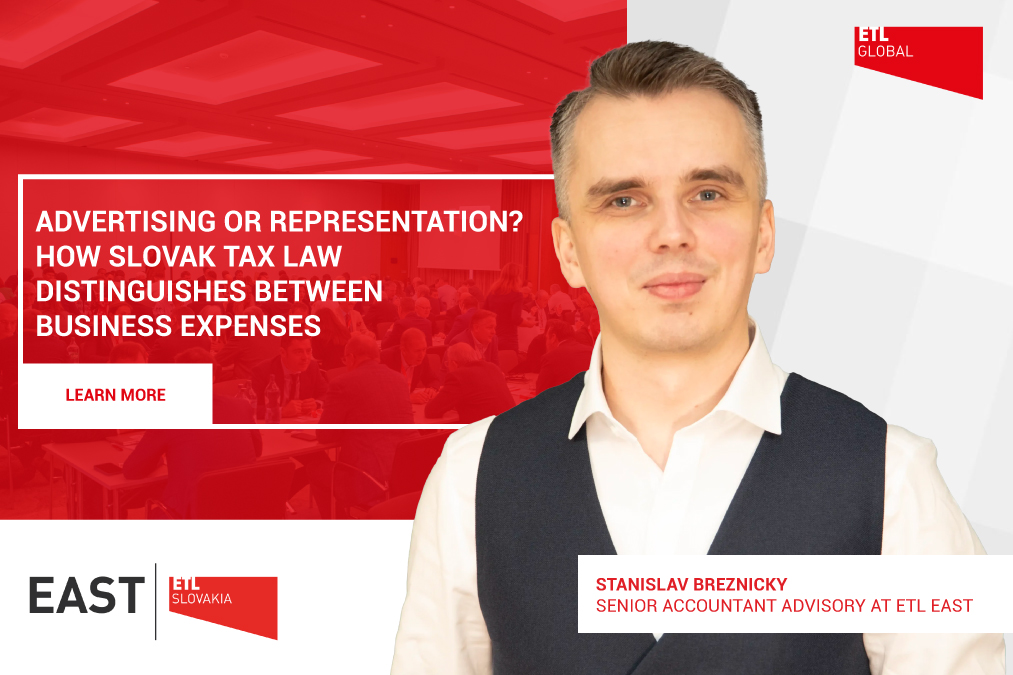
Across Europe, the way companies record everyday costs such as client gifts, hospitality, or branded materials plays an important role in their tax position. The distinction between advertising and representation exists in most tax systems, but how it is applied can differ. In Slovakia, the Income Tax Act provides a clear framework for this classification, and understanding it can help businesses avoid errors in both accounting and taxation.

In this article, ETL SLOVAKIA highlights how Slovak rules interpret typical business expenses and why this distinction remains a recurring issue for many organisations. While advertising costs may, under certain conditions, reduce the tax base, representation expenses generally cannot. The difference might seem subtle, yet it can have a measurable impact on financial reporting and compliance.

Read the full article by ETL SLOVAKIA for further insight into how Slovak law approaches this area of taxation.

ETL GLOBAL

Follow & Subscribe

SEARCH THIS BLOG

OTHER POSTS YOU CAN'T MISS

Hungary brings back the Advertising Tax

Hungary brings back the Advertising Tax

The advertising tax was first introduced into the Hungarian tax system in 2014. Following significant amendments adopted in 2017, its application was suspended in 2019. After the most recent legislative changes, the advertising tax will again apply as of 1 July 2026,...

TP Audits and Controversy: Focus Areas in Romania and Germany

TP Audits and Controversy: Focus Areas in Romania and Germany

Transfer pricing audits conducted by tax authorities are no longer regarded as a purely formal exercise. In recent years, authorities have developed an increasingly analytical approach, based on detailed financial testing and a strict interpretation of the arm’s...

Beckham Law: New DGT Guidance on Foreign Entity Participation

Beckham Law: New DGT Guidance on Foreign Entity Participation

The application of the “Beckham Law” continues to raise technical questions, particularly where internationally mobile professionals maintain interests in foreign entities. Clarifying the limits of what may constitute a permanent establishment in Spain is therefore...

Subscribe to ETL GLOBAL's Newsletter

Sign up to receive weekly news of ETL GLOBAL.

You have successfully subscribed

Subscribe to ETL GLOBAL's Newsletter

Sign up to receive weekly news of ETL GLOBAL.

You have successfully subscribed

Subscribe to ETL GLOBAL's Newsletter

Sign up to receive weekly news of ETL GLOBAL.

You have successfully subscribed